
AMVR FC4 Review: The Better AMVR Facial Interface for Halo Straps
The AMVR FC4 gives Quest 3 halo-strap users more forehead clearance, precise glasses spacing and a large FOV on my face, but it is difficult to recommend at full price.
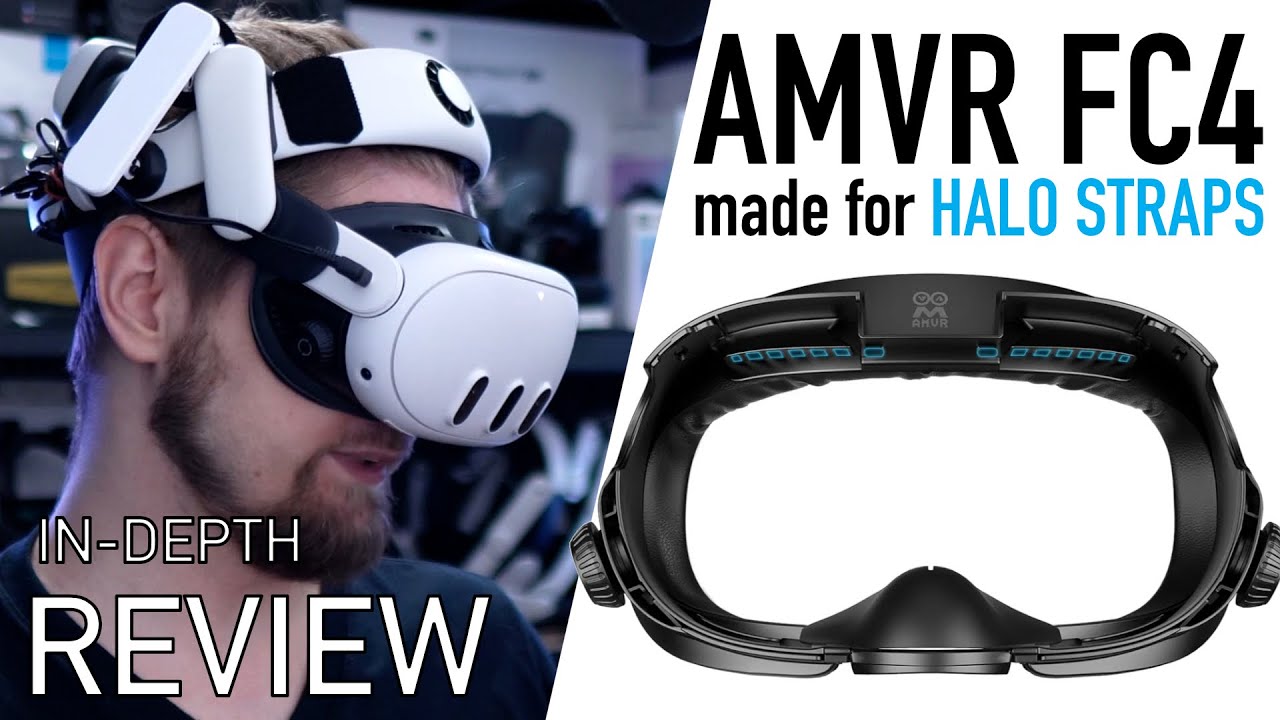
Want the full version? The video review includes all the demonstrations, comparisons and extra details that are easier to show than describe.
Watch the full review on YouTubeDisclosure: The review unit was sent to me for free by AMVR. I use affiliate links always when they are available. If you buy through one of them, I may earn a commission at no extra cost to you.
Quick verdict
The FC4 is the AMVR facial interface I would choose for a halo-style head strap. It is very comfortable on my face, gives the halo band and headset plenty of adjustment room, works properly with the fan on my BOBOVR S3 Pro and has precise knobs for glasses or prescription lens inserts.
My main problem is value. At the roughly $40 price, KKCOBVR offered an interface with a fan in the same price range, while the Globular Cluster interface was often promoted to about the same effective price. The FC4 is a very good product, but it makes more sense on promotion.
Most importantly, do not confuse the two AMVR versions: FC4 is the halo-strap model. If you use an elite-style strap, FC3 is the better choice!
Pros
- Precise spacing knobs add up to 9 mm of clearance for glasses
- Short forehead section leaves room to change halo height and headset angle
- Large FOV on my face, with enough range to move the lenses back when needed
- Leaves space for the BOBOVR S3 Pro fan to cool my forehead
- Only minor light leakage in my testing
- Includes both PU-leather and Ice Silk pads
Cons
- Poorer value than some competitors at the roughly $40 review-time price
- The “cooling gel” made no temperature difference for me
- Side light leakage increases at maximum glasses spacing
FC4 is for halo straps; FC3 is for elite straps
The FC4 looks similar to AMVR’s earlier FC3, but the geometry is meaningfully different. With the FC4 installed, there is still a large gap between the top of the facial interface and the forehead section of a halo strap. I can move the halo lower or higher and tilt the headset up or down without the two parts colliding.
That freedom is especially useful with prescription lenses and astigmatism, where the visor angle can affect how well the lenses line up. The FC3 happened to sit at a suitable angle on my head, but it did not let me adjust that angle nearly as freely. On the FC4, I can position it almost however I want, much like I can with the Globular Cluster interface.
This distinction is simple: buy the FC4 for a halo strap and the FC3 for an elite-style strap. I would not buy FC4 for an elite strap.
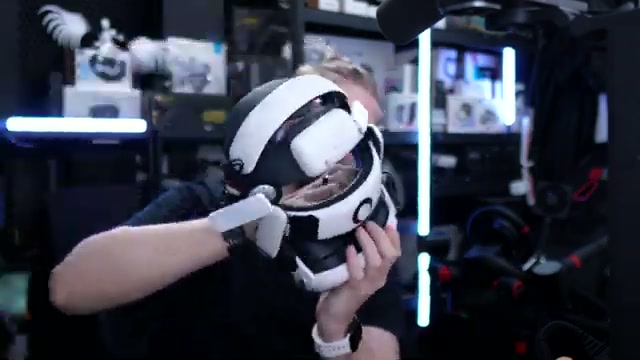 The FC4 shown with the Quest 3 and a halo-style strap setup.
Pads, cooling gel and comfort
The FC4 comes with a PU-leather pad already installed and a second pad that AMVR calls Ice Silk. Both contain what AMVR describes as cooling gel. In my experience, the gel is too small to transfer enough heat to change the temperature of my forehead. I consider that a marketing feature rather than a real cooling benefit.
Comfort is much more important, and here the FC4 is very good. On my face it belongs in the same comfort group as my favorite Globular Cluster and KKCOBVR interfaces. Face shape changes everything with a facial interface, though, so someone else could have the opposite result.
I can use the Ice Silk pad comfortably, and many people may even prefer its softer feel. I usually play active games and sweat a lot, so I strongly prefer the PU-leather pad because it is easier to deal with in that situation.
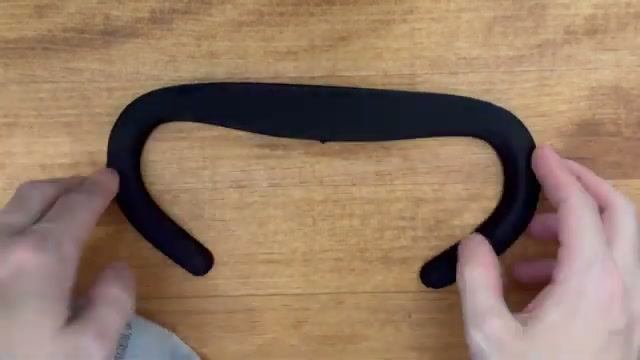 The FC4 interface shown during the unboxing.
Glasses adjustment and field of view
The side knobs let me adjust the headset-to-face distance very precisely. The maximum range is 9 mm, which should be enough for most glasses and is more than enough for prescription lens inserts.
On my face, the FC4 also gives me a large field of view. I can bring the Quest 3 so close that it touches my eyebrows. In fact, even without glasses or prescription inserts, I prefer to move it slightly farther away with the knobs or the halo adjustment.
This is not a universal FOV measurement. The same interface can sit very close on one face and much farther away on another, so your result may be completely different. The compressible PU-leather pad is about 15 mm thick, which I consider fairly average, but even that number cannot predict how it will compress on every face.
Measurements and forehead clearance
The reduced forehead pad is the biggest physical difference between FC3. My approximate measurements were:
- FC4 front plastic projection: almost 3 cm
- FC3 front plastic projection: 3.8 cm
- FC4 central soft forehead section: about 2.3–2.4 cm
- FC3 central soft section: more than 3.5 cm
- FC4 PU-leather pad: about 15 mm, although it compresses and is difficult to measure precisely
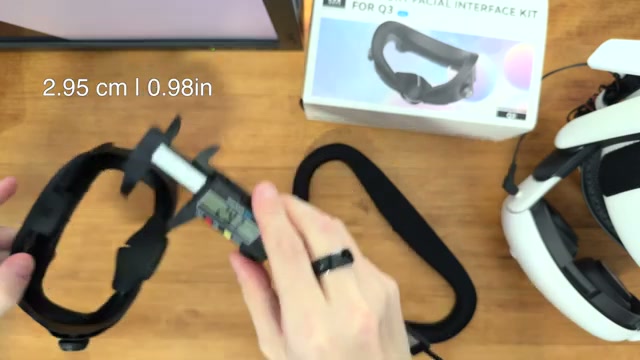 The FC4 forehead section measured 2.95 cm in the video.
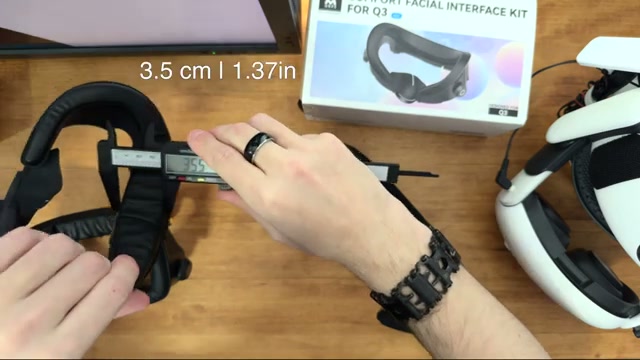 The FC3 comparison section measured 3.5 cm in the video.
Airflow with the BOBOVR S3 Pro
With the FC4 on my BOBOVR S3 Pro, there is enough open space for its fan to blow air onto my forehead. The taller FC3 almost blocked this path, leaving my forehead warmer and making the fan much less useful.
That matters to me because I live in Thailand and sometimes play without air conditioning. With FC4, the S3 Pro fan makes a huge difference. With FC3, I could barely feel it.
The FC4 is still physically larger and more closed than the Globular Cluster interface. However, I no longer felt a huge cooling difference between them when using the S3 Pro fan.
Vents, fogging and light leakage
FC4 has four vents, with two on top and two on the bottom. FC3 has only two upper vents. I did not notice a practical ventilation difference between them, and I cannot properly judge whether the extra vents reduce fogging because my Quest 3 does not fog during normal use.
More vents can also create more opportunities for light to enter. This was a serious problem on the old AMVR Q3FC2, where I had to cover openings with tape. FC4 is much better.
At the close setting, I could find a small leak at the side, but I usually could not see it during gameplay. At the maximum 9 mm glasses setting, the side leaks became larger, but they were still small enough not to bother me.
The flashlight made them look much more obvious than normal daylight or a ceiling light. I did not need tape, and this was nothing like the leakage from the old FC2. Your result can still vary with face shape, visor position, room lighting and the amount of spacing you use.
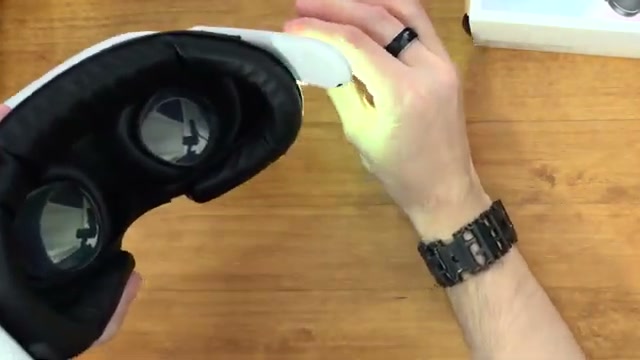 A flashlight test checking for light entering around the FC4.
Installation, removal and weight
Installation is straightforward. To remove the FC4 without disturbing the adjustment, I squeeze both sides firmly with my fingers and then pull it away. If I pull without squeezing, the knobs may not hold their position. That is normal for an interface with this kind of adjustment, and the squeezing technique solved it for me.
The scale showed the FC4 at almost 96 g, compared with 102.5 g for the elite-oriented FC3. The FC4 is therefore slightly lighter by those readings, although facial-interface weight does not make a meaningful difference to me.
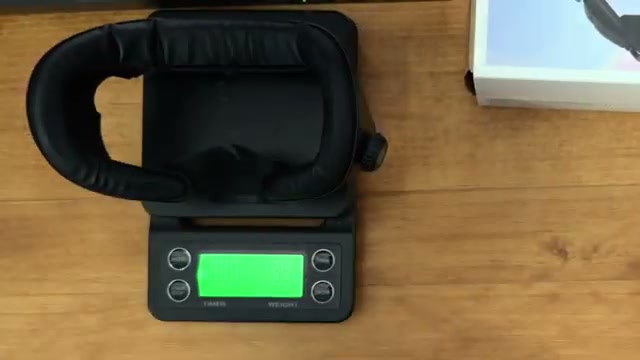 The FC4 on a digital scale during the weight test.
Value compared with Globular Cluster and KKCOBVR
At the time of my review, FC4 was roughly $40. At that price, I thought it was the worse deal. KKCOBVR had an interface in the same price range that included a fan. The Globular Cluster interface was listed at $60 but was frequently promoted to around $40, offering similarly excellent comfort and very free angle adjustment.
AMVR had an important advantage: availability. Its interface was consistently in stock and shipped to many countries, while Globular Cluster and KKCOBVR were more limited and could be more difficult to order depending on where you lived.
If FC4 had been my only facial interface, I would have been very happy with it. Everything important is at least good, and several parts (comfort, halo clearance, the adjustment knobs) are excellent. It simply needed to be a little cheaper relative to the alternatives.
Should you buy it?
Buy the AMVR FC4 if you use a halo-style strap, want precise glasses adjustments, need freedom to adjust the headset angle or want to keep the airflow path open beneath a BOBOVR S3 Pro. It is also a sensible option if competing interfaces are unavailable where you live. Comfort and FOV were excellent on my face, but both remain face-dependent.
I would look for a promotion rather than paying the roughly $40 price from the review period. If you already have an elite-style strap, skip FC4 and choose the AMVR FC3 instead. For halo users at the right price, FC4 is a very good facial interface.
Interested in AMVR FC4?
These are the same affiliate links I use below my YouTube videos. They cost you nothing extra and help support the channel.